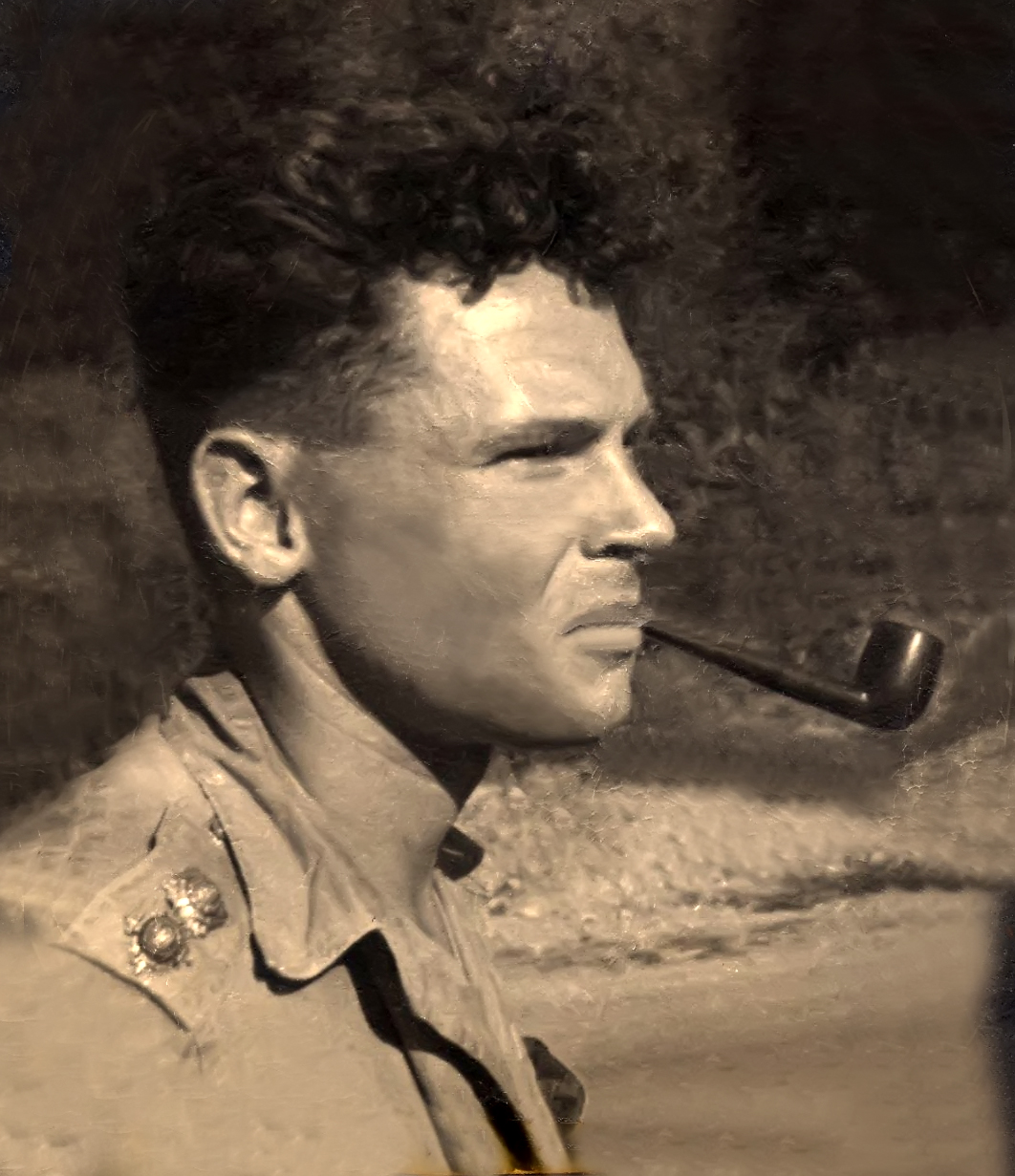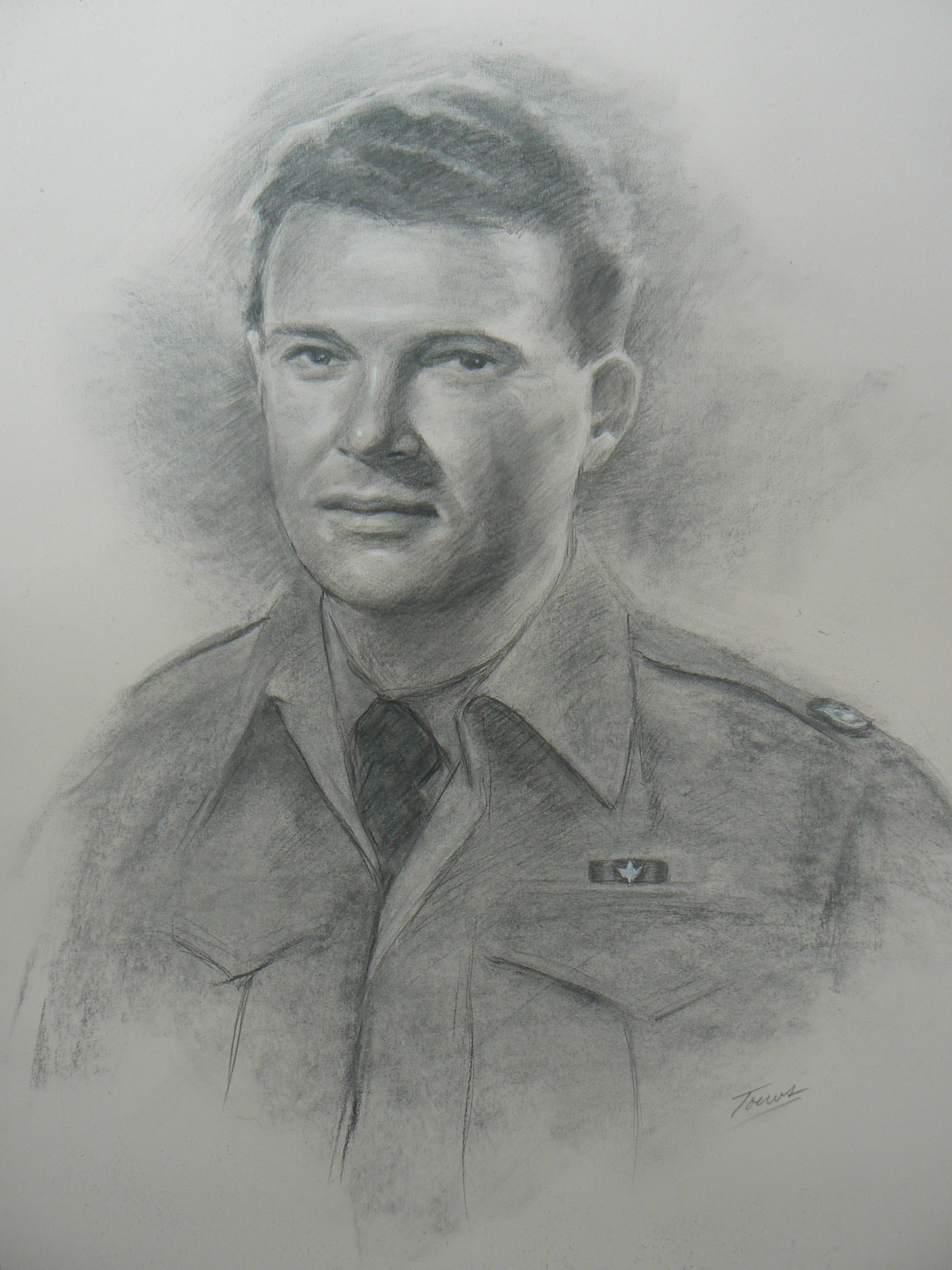

Bob Paterson was born in Hamilton in 1916 and grew up on Homewood Avenue
in the city’s west end. He graduated from McMaster University in 1938 and then went
to work in Toronto for London Life. He was, as he put it, vaguely away
of events in Europe but “life pretty well went on.” A sportsman all of
his life (he acquired the nickname “Flan” for his devotion to flannel
socks), he was in Algonquin Park in May 1940, fishing with his dad, when
the German army broke through the famed Maginot Line. “Then I knew that
the game was up…. I knew it was an all or nothing situation. You just
damn well had to join.”
Paterson had begun officers’ training in September 1939 when the war
broke out. He had his qualifications as a gunner and tried,
unsuccessfully, to join the Guelph and then the Hamilton battery in May
1940. His brother-in-law, 2Lt Dave Duncan, was in the Argylls and
“telephoned one night in June and said, ‘The Argylls are being
mobilized, seven or eight of your friends from McMaster and myself have
all joined up. Why don’t you come down and take a crack at it?’ And
that’s how I got into the Argylls.”
The introduction to military proved as interesting for Paterson as it
did for most others: “My commission was dated June and I was taken on
… provisional second lieutenant, supernumerary … I was the lowest of
the low.” He admitted to being “pretty green…. We had no military
training at all. We didn’t know how to dress properly, how to salute,
how to march, how to do a damn thing, and [we] were given men to
command. It was pretty awful.”
In time, Paterson, like the men of the Battalion as a whole, became soldiers. His
brief artillery training made him a natural fit for command of the
mortar platoon, although it did not have any mortars for some time. Years
later, 2Lt Pete Stephen could still “see him out on the training area,
trying to teach them how to fire a mortar with a piece of stovepipe and
sticks of wood that fitted in the stovepipe.” But leadership does not
depend on equipment, and Paterson was making an impact on his men without
it. Pte Mike Forester, a tough young lad from Grimsby, thought, “Oh gosh,
Paterson was a prince. I really liked [him]…. He was a very
quiet-spoken man…. He had that knack about him, treated everybody the
same, and he was very well liked … he was one of the men, just like Al
Rathbone [later long-time OC of the Mortar Platoon]. He had that same
disposition.”
From Niagara to Nanaimo to Jamaica, Paterson acquired the
professionalism of soldiering and deepened his friendships with fellow
subalterns such as Alex Logie and Jack Harper. On the way to Jamaica, he
and several other Argylls met the Duke and Duchess of Windsor in
Bermuda, where the erstwhile king had been sent in the vain hope that it
would keep him out of trouble. There was time for golfing and golf was
to Bob Paterson like a muse to a poet. Paterson himself loved novels and
wrote well. His account of the Agapenor incident reads like a Graham
Greene novel. It was March 1943. Paterson and Logie, with a section each,
had been sent to act as guards on the ship after a mutiny. They were
sent to Colombia to board a flying boat dressed in ill-fitting white
suits with army boots and suitcases full of sub-machine guns, rifles,
and ammunition:
[W]e landed at Barranquilla in Colombia, spent the night there. The boys
begged me to let them [out] … the place was full of Germans. I was
terrified of them getting into trouble or something, but I let them, I
think, from oh, say, five o’clock in the afternoon until they had to
report back to the hotel at nine. And apparently they got into a
whorehouse or something, and they were just about to enjoy themselves
and the sergeant, I think, said “It’s ten minutes to nine,” and they
cursed me to beat hell and everything, and they got back. They all got
back to the hotel.But the funny part was that we went into the hotel and I went up to the
reception desk and asked about our rooms and so on, and the German –
she was a German lady, blonde hair, big – she said, before I said
anything, “Good afternoon, Lieutenant Paterson, your rooms are ready.” I
thought, “Jesus!” … [I learned years later] that same women … was
notorious, she was one of the head spies in Colombia.
While in Jamaica, Paterson had substituted for the adjutant, Capt Art
Hay, when he was absent. When Hay went to RMC in August 1942, Paterson
became the acting adjutant, and on 6 Feb. 1943, Lt Paterson became the
adjutant, an important position within the Battalion. It was a mark of
his ability, and he was promoted over a lot of other officers. Not
surprisingly, in some quarters, his appointment caused some small bit of
jealousy. But Paterson loved it: “I liked being adjutant very much … you were your own boss and well,
you answered to the Colonel obviously, but you did all the
administration. It was very busy…. The most difficult thing I ever did
in the army.”
As the Battalion prepared to go overseas in 1943, much of the work fell
to Paterson. Hay became the acting CO and things changed, and for
Paterson too:
He [Art Hay] worked the hell out of everybody. Soon as he took over the
unit … I wasn’t Bob anymore, I was Paterson – and that kind of made
me mad. He was like that … and he’d upset other people, doing other
things … I guess he worked us too hard. He really did.He’d have all the officers running up at Huntstanton, I remember.
Adjutant, anybody, we’d go out, after supper at night…. We’d worked
all day, then we’d go for a four-mile run. Jesus … he got me down. He
really did.There seems to be about [a] fifty-fifty split. Some give him [Art
Hay] credit for keeping the unit together, and others have said … it
[the officer training] was basically a pain in the ass. They said they
didn’t appreciate … sand-table schemes in the Mess, and having to keep
up the next morning.I think he was a theorist and I think he was heavy-handed. He
wouldn’t think of what we were thinking, and there was no empathy….
There was something to be done and he would draw up the operation order
– [a] brilliant operation order – but it probably was not practical
… like Haig in the First World War.
On 19 Sept. 1943, Lt Don Seldon, 2IC of C Coy, learned from “Hay … that I
am to become Adjutant and will take over from Bob Paterson in the near
future.” Shortly thereafter, the Argylls got their new CO, LCol Dave
Stewart. “I remember,” Paterson said, “ I was the Adjutant. It was
raining, and he blew in and, out of the night … ‘I’m your new CO.’
Right from the start, everybody liked him. Everybody liked him. He won
us all over in ten minutes. He had great charm and he was very decisive.
Awfully nice guy. We just thought he was great.” Stewart “appealed to
other ranks and the NCOs and the officers in quite a different way. He
seemed to sense the differences and he was a sensitive man. He knew what
I was thinking and what the other guys were thinking, and he was very
smooth.” That was Stewart the man and the leader and then there was
Stewart the CO: “I can remember his first
operation order: verbal, simple, everybody could understand it; the most
beautiful thing I ever heard. An idiot could have carried out his plan
of attack, or whatever it was, and I thought, ‘Boy, this is for me.’”
Stewart had made his mark and it was indelible. In early October, after
a bit of a handover, Seldon and Paterson traded appointments.
Maj Gordon Winfield commanded C Coy. A bully and a braggart with a
“terrific temper,” he became increasingly hesitant about command.
Increasingly, he left matters to his 2ic. The CO was also aware of
Winfield’s shortcomings and, years after the war, admitted his lack of
experience in getting rid of senior officers. “Dave Stewart asked me
before D-Day if I thought he [Winfield] could command the troops, and I
said no. Told him flatly that he could not command.” When the company
went into action, Paterson, like the other 2ICs, was left out of battle.
CSM George Mitchell of C Coy was privately scathing about Winfield’s
performance. When he was slightly wounded at St Lambert in late August,
he was sent back to England. For his part, Stewart was determined he
would never return. When the Battalion finally received badly needed
reinforcements in the early days of September, Paterson became OC of C;
Jack Harper had A, Logie had B, and Pete MacKenzie had D – a new
generation had taken over.
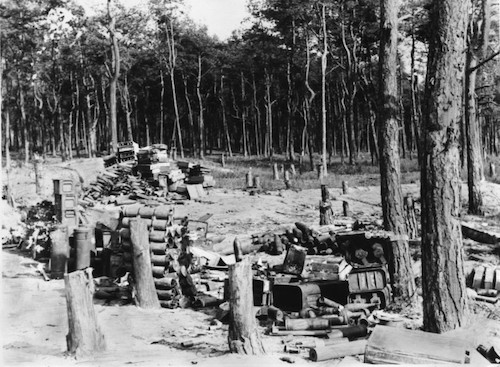
Paterson was shocked by the horror of war so evident at Falaise: “I was
stunned by the magnitude of the thing [German retreat from Falaise], the
magnitude of the dead and the horses and broken up wagons and debris
scattered all over. And the smell, we were all half sick. It was just
… horrible. I called it in the history [of the 10th Brigade] a charnel
house.”
The months of September and October leading up to the winter sojourn on
the Maas River witnessed heavy fighting and, with it, the attendant
casualties. One of the best examples of Argyll determination and
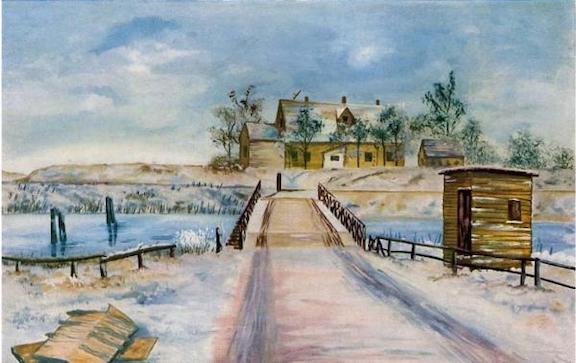
doggedness was that of C Coy at Moerbrugge (8–10 Sept). Dave Stewart had taken
over the brigade and an inept and disliked Maj Bill Stockloser took over
the battalion. The Argylls, led by C and D Coys, were to cross the canal
unsupported and without assault craft. Stockloser, when pressed by
Paterson how they were to cross without boats, described it as “a
crossing of opportunity.” The companies sustained heavy casualties,
crossing in leaking rowboats without oars. MacKenzie was wounded in the
early going and C Company was cut off by an unexpectedly fierce German
resistance. C Coy was isolated in one building. Paterson put his Bren
gunners in the upper windows and all ammunition went to them; the effect
upon the attacking Germans was devastating. On the morning of the
10th, they had run out of ammunition. By the night of the 9th,
Paterson wrote:
There was no communication by wireless or by runner. The company was
perilously short of ammunition, and had no rations. Still the whole town
was ablaze that day with small arms fire, grenades and piats. The air
was a frenzy of automatic fire and the shouts and groans of wounded
Germans. No one knows how many attacks they made, but there were many.
Their stretcher bearers worked all day and were permitted into the
company lines to clear the dead and wounded. It was the wildest show and
the bloodiest for a long time. Toward evening the enemy teed up what was
to be his last attempt at dislodging us.
C Coy held on and was prepared to fight on. Bob Paterson had said he
would have been happy to stay in Jamaica for the war or for a successful
Stauffenberg plot end the war and the necessity for fighting. This
quiet, reflective man, given to poetry and novels, had no intention of
giving up:
I had thirty men, and they were all there. You didn’t have to give any
orders. They were going to fight, they were all going to fight…. Never
thought of [surrendering]. Never entered my mind. Didn’t enter [CSM]
Mitchell’s mind. Didn’t enter any of the men’s minds, that I know of …
I thought that was the end…. [But] I think I was too exhausted to be
afraid … I was fatalistic at that point. I’m no hero. I was no hero at
all … there were no heroics in my mind. I was beyond that point.
Happily, in the early morning hours of the 10th, the RCE bridged the
canal and shortly afterwards the tanks of the South Alberta Regiment
crossed and relieved the besieged company: “You could hear the [SAR]
engines start up,” Paterson remembered, “and we knew they were
coming. And Jesus, what a glorious moment, I’ll tell you.” A month or so
later, several Argylls, including the CSM, were awarded medals for this
action but not Paterson. His 2IC, Capt Sam Chapman, commented in a letter
home: “But Paterson was the man who decided they’d stay + fight to the
last man – if it came to that – which decision in my opinion required
more guts than all sorts of spectacularly brave acts.”
The fighting, the casualties, the isolation from brother officers, the
death of Alex Logie on 20 Oct. 1944, and the lack of reinforcements took
their toll on Bob Paterson in the days leading up to early November.
Then, LCol Stewart left and Stockloser was in charge again. Paterson had
had it: “You were just exhausted … to hell with the booze and
women.” He was equally tired of leadership at higher levels: “Shit, you
didn’t have a hope in hell. And I was very critical as I went on, and I
got worse. The longer I was in the line, the worse I felt about the
goddamn command set-up … I gave up trying to be logical after a
while.” Had he been certain of Stewart’s return, he could not have
left. On 19 November, Sam Chapman wrote to his wife: “Major Paterson just
got word that he is going to brigade on staff. He’s seen a lot of
fighting and deserves a break – anybody who’s been lucky that long
shouldn’t try his luck too far.” For his part, “I was seconded, but I
left to all intents and purposes … I couldn’t take it any more. I was
having convulsions at night … and I couldn’t stand up straight…. And
I was terrified of doing that in front of the men, and I didn’t tell
anybody … so I applied for a staff posting…. I had lost all my pals:
Logie, Harper, everybody I knew gone, except Pete. Pete Mackenzie came
back. I’d lost anybody I knew. Johnny Farmer’d gone, Coons had gone.”
Bob Paterson was with the 10th Brigade until the end of fighting. He
returned to the Argylls as a company commander and participated in
several of the celebrations. Given the task of writing the history of
the 10th Brigade, he penned a short, incisive, and eloquent chronicle.
He returned home, moved to Brantford, Ontario, where he opened a business, had a
home backing on to a golf course (his idea of heaven), married Peggy,
and had two sons: Robert Alexander and Ian. His sister, Janet, married
Hugh Maclean.
Like Logie and Maclean, he, too, would be remembered with respect by his
men. A private in C Coy, John Evans (in the lower right of the famous
picture of Maj Dave Currie winning the VC at St Lambert), was a crusty,
disagreeable commissioner at the Armouries, a man seemingly incapable of
the slightest gesture of respect to anyone regardless of rank. At a mess
dinner in the late 1980s, Maj Paterson was walking in and passed Evans,
who snapped to attention and saluted. While they chatted briefly, Evans
remained at attention and saluted again when Paterson departed. “Best
damn officer I ever served under,” Evans snorted to no one in particular
and then reverted to his churlish ways. Paterson was a fine officer and,
like Logie and Maclean, an equally decent man with a sharp intelligence
and genuine modesty.
When, in 1986, Claude Bissell was interviewed, he began by reading the
last two paragraphs of Paterson’s history of the 10th Brigade. They
had, Bissell thought, a “symphonic” quality and expressed perfectly how
soldiers in battle felt. Paterson was explaining why, when huge crowds
in the major cities of the Western world greeted news of the war’s end
with rejoicing, soldiers in the field of battle were mute. On 27 April,
he wrote to Phyllis Logie: “We are being sporadically shelled, our guns
and rockets startle the beautiful spring nights. It’s all madness, a
fantasy. Each day we say to-morrow – and yet it’s still to-morrow.”
That understanding informed the last paragraph of his history, and those
words inspired the title of Black Yesterdays: The Argylls’ War:
Perhaps in the months to come will that fabulous “to-morrow” really be
to-day – a day when all the bells and voices of our great memories
shall ring out, cry out, peal, and shout, in one wild tumultuous song
of thanksgiving. Sometime, while dreaming over a sun drenched lake,
while pausing in the fields to watch the summer clouds pile one upon the
other, or in the quiet half hour before sleep, we shall hear that
symphony we once listened for, and it shall swell and reverberate
through our beings in unforgettable strength and beauty so that we shall
know that to-day has come, and that those black yesterdays are
forever left behind.
Robert L. Fraser
Regimental Historian