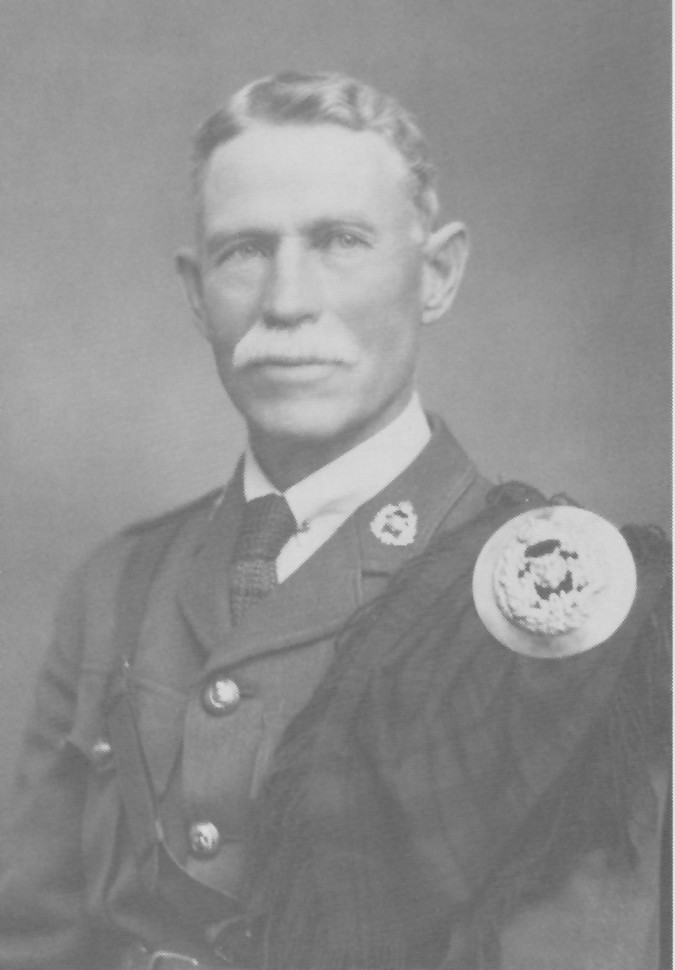
It is worth recalling briefly the man most responsible for the
Regiment’s founding. James Chisholm was born in Hamilton and died here.
Educated locally, he was a model student who won a scholarship to the
University of Toronto. He graduated with high honours and then studied law, joining a local firm in 1882. He quickly rose to a
partnership and then became a partner of William Alexander Logie.
The two men shared a passion for the law, a Highland background, the
Presbyterian faith, Liberal political affiliations, and military
interests. Indeed, after the death of Chisholm’s bride of less than a year, the
benchmarks of his life were his practice, his church (MacNab
Street Presbyterian), and his Regiment. His practice flourished, he
became a stalwart of MacNab, and he became the president of the Hamilton
Liberal Association (1903–23), an elite group that ran local party
affairs with an iron, quasi-aristocratic grip.
Chisholm’s passion was the military. He evinced an interest in it
early, serving as a private in the Queen’s Own Rifles from 1877 to 1879, after which it lapsed
until the early 1900s. The idea for a full Highland regiment in Hamilton
“first took shape among the members of the St Andrew’s Society [of
which Chisholm was the long-time treasurer] and the Sons of Scotland [of
which he was also a member.] Late in 1902, meetings were held and
prominent members of the city’s Scottish-Canadian community were asked
to “take hold of the matter.” Chisholm and Logie took the leading role
in organizing locally and lobbying a reluctant Liberal government. The
minister wanted a common uniform for the regulars and militia, while his
staff members were skeptical of the group’s ability to raise men and money for
kit.
Both had underestimated the determined Chisholm. Early in 1903, he wrote
to local MPs, informing them that the proposed “officers are a fine lot
of fellows and of good standing and large influence in the community.”
By March, he had over 700 names on the proposed nominal roll of the rank
and file. In spite of continuing opposition from the minister, Sir Frederick Borden, Chisholm was dogged, and by 17 Aug. 1903 Borden reported
confidentially that he would authorize the raising of a Highland
regiment. Chisholm, Logie, and the Scottish community were unrelenting
and politically adept, and, in the end, they won the day. The Regiment
was formed on 13 Sept. 1903 and gazetted three days later as the
91st Regiment Canadian Highlanders.
James Chisholm joined the unit on 16 Sept. 1903 as paymaster with
the rank of honorary captain. For the remainder of his life, the
Regiment was a consuming passion. He maintained a particular interest in
the establishment of Highland traditions, the welfare of the Pipes and
Drums, and the life of the Officers’ Mess. He was promoted honorary
major on 16 Sept. 1913; he went overseas with the 173rd Battalion in
1916; and he retired from active service in 1920. On 19 Dec. 1924, he
became honorary lieutenant colonel, an appointment that afforded him “great pleasure … I have always felt that I was very much the gainer
personally by my association with the men who formed it and those who
carried on in their place.” On 3 May 1932, he was awarded the ED and
retired from his appointment in 1935, only to become honorary colonel the
following year.
Chisholm died on 21 Nov. 1944 and was buried by his Regiment with full
military honors. Hamiltonians had become accustomed to seeing him walk
to the Armouries, “that amazingly alert soldierly figure with his cane,
swinging along James Street.” His minister described him as a “gentleman
of the old school … proud of his Scottish ancestry … proud of his
Scottish regiment.” He was a man of high character, virtue, “a brilliant
mind and a generous heart.” He left his estate to his family, his
church, and his Regiment. A private man to the end, he noted in his
will the advice to “Keep out of newspapers.”
Robert L. Fraser
Regimental Historian