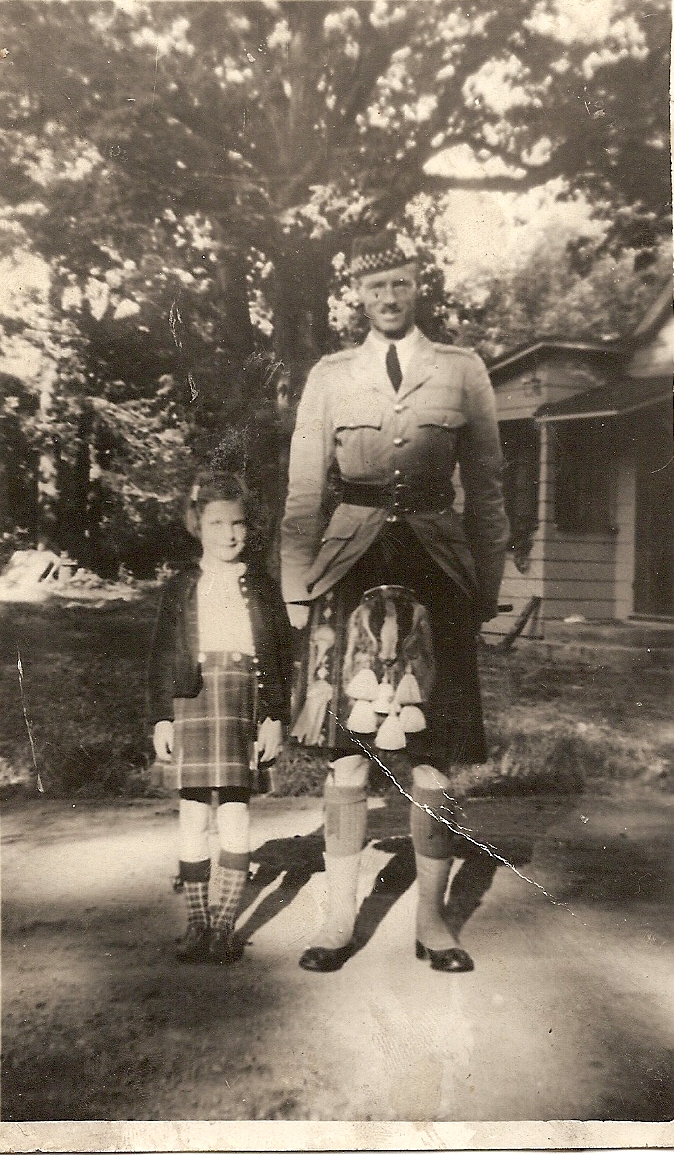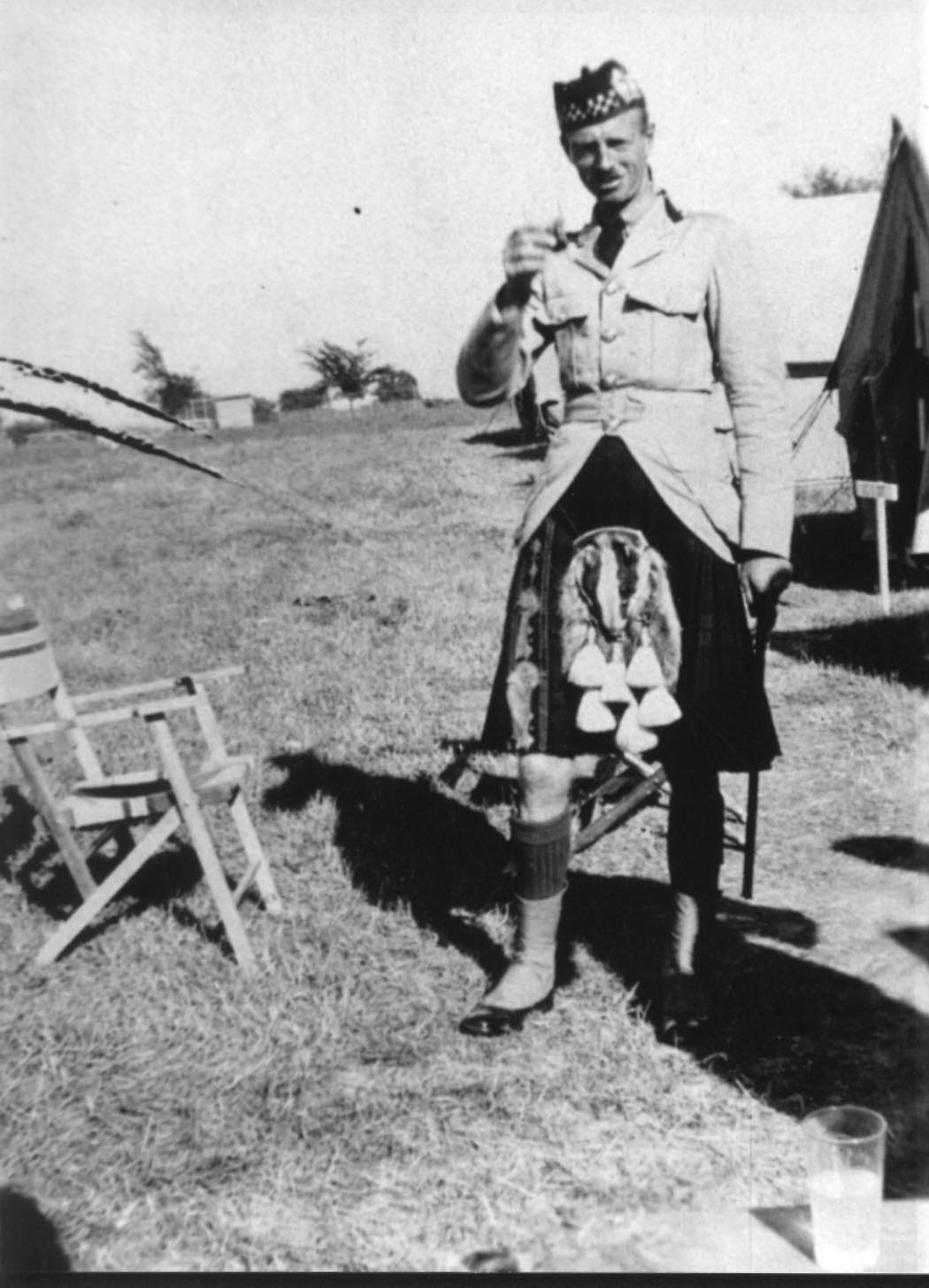
Alex Logie was a natural fit for the Argylls, the son of Major-General
William Alexander Logie (1866–1903), one of the Regiment’s founders and
its first commanding officer. In some ways, he was a 91st Highlander
(the Regiment was raised in 1903) before he was even born in 1906 in Hamilton. He was educated locally and at Upper Canada College. Although
the family had moved to Toronto when his father was appointed to the
Ontario Supreme Court, the Argylls would remain the family’s Regiment.
After the mobilization of the lst Battalion in 1940, 2/Lt Logie was
taken on strength almost immediately. Unlike many of his exalted rank,
Logie was older, married (Phyllis Lash Cassels in 1930), and had
two children (Robert, known as Robin; and Joyce, known as Joy).
Alex Logie took to active soldiering with relish, dedication, and his
own style. The men of 18 Platoon, D Coy, which he commanded, remembered
fondly his playing taps on his harmonica to close down the day while
patrolling the Welland Canal. At times, he checked the troops on guard
duty by canoe: “We thought,” one said, “he was Hiawatha.” The
battalion’s movement from Niagara to Nanaimo to Jamaica brought
further training for Logie, closer integration into the unit and the
cadre of young officers, and adventures such as providing the guard,
along with Lt Bob Paterson, on the Agapenor in March 1942. A senior
lieutenant, there were times, remembered his good friend Lt Jack Harper,
that Logie “felt that he wasn’t getting a fair shake. He was a senior
… lieutenant … one of the best in terms of being a soldier.”
In March 1943, Lt Logie left Jamaica for courses in Canada and then a
three-month tour “overseas.” He was over 35, a cut-off age for active
service, and the Battalion would be returning soon to Canada. Logie
wanted to get into the war and not be left behind; the Battalion
conspired to get him overseas before it and, thus, ensure the
fulfillment of his wishes. As expected, older officers and soldiers were
left behind when the Battalion went to England in the summer of 1943.
Now a captain, Logie continued to write frequently to his wife and
children, to train hard, and to await what lay ahead in northwest Europe.
The Battalion moved into the theatre of operations and Logie was
second-in-command (2IC) of one of the four rifle companies. In the early
days of fighting, the 2ICs were left out of battle to ensure continuity
of leadership should the officer commanding (OC) be killed or wounded. As
Capt Bob Paterson, 2IC of C Coy, remembered: “[Captains] Logie, Harper,
Zavitz and myself … we were all left out of the battle … at first.”
It was not for long. After the engagements of early August and the B and C
Companies’ battles at St Lambert (18–21 August), casualties had mounted.
B Coy had lost two OCs (one wounded, the other killed), and C Coy had
lost one (wounded). The losses were so heavy that on 22 August “B” and
“C” Companies were amalgamated into one unit under Captain Logie. Finally, on 4 September, there were sufficient reinforcements to
reinstate the four rifle companies; Alex Logie, now an acting major, had
B; his best friend, Bob Paterson, had C.
For the remainder of his life, Logie had two major concerns: B Coy
and his family. In the spare moments that the former allowed him, he
took time for the latter. On 15 September, he wrote his wife:
Here I am again stopped for a few moments so I though I would take time
by the forelock and write you a line or two, just to say I am fine and
everything is going well. At the moment I am sitting in the living room
of a house, with my carrier outside the window and the radio extension
in here and am listening (against orders) to a concert from London which
is grand for a change. I have been up all night and snatched a couple of
hours sleep this morning. Things are pretty quiet at the moment except
for the odd mortar bomb + shell coming over at random nothing to worry
about though when you are in a house … Every thing is going well in
the Company and I think the C.O. is quite pleased with the work of the
2i/c’s [sic]…. I am happier every day about this Coy though the men for
the most part are doing a grand job and I have two very good officers
and one fair one and a very good sgt major [C. MacDonald] whom I picked
myself from Dog Coy and who is my right hand man.
Another brief lull on 20 September meant time for another letter to his
beloved Phyllis:
Two lets from you today and one from Rob + Joy [Logie’s two children]
with the snaps in it. God! You have no idea how wonderful it is to get
them my Precious … Gosh! the snaps are grand Petty I just loved them
but I wish you wouldn’t cut yourself out of any of them because even if
you had a squint a mile long you would still be the most lovely thing on
earth … Now Woofie Darling a wee word to you. This is your birthday
and I have been thinking of you so much all morning and looking and your
face and wishing I could be there. I love you my own Lovely one. Keep a
stiff upper lip till Old Hub gets home again. God Bless you.
Ten days later, he wrote: “God! I’ll be glad to get out for a while
where I don’t have to worry about a damn thing…” On 2 October, he
looked forward to a brief leave: “…I think Bob [A/Major Paterson] and
I will take a trip into the recreational city [Ghent] tomorrow if there
is nothing doing. I hear you can get ice cream cones cherry pie, see a
show and if you are interested in these sort of things watch “the Madam”
parade her 10 lovely girls from one house of ill fame to another…”
Although essential to emotional and physical health, these short leaves
were only diversions from the reality of battle and Logie confided to
Phyllis that: “…It’s a miserable business sometimes Dear Heart but
nothing can be done and you just have to get hardened to it… “ On 10
October, he took out another recce patrol; LCol Dave Stewart was not
pleased: “I was out all day on a patrol and when the C.O. came in to see
me tonight and I told him, he got mad as hell and said ‘This is an
order, you will not take out any patrols in future.’ I guess he is right
but I hate like hell having my subalterns do them all the time.”
The life of an OC in battle was lonely. There was almost no contact with
friends and fellow officers and casualties were part of daily life.
Logie personified a leadership style that was compassionate. He cared
for his men and worried about young subalterns on the always dangerous
patrols. The late Lord Peter Blaker was one such officer and recalled
vividly and poignantly Alex Logie’s manifest concern for his personal
well-being.
…I was surprised to find my company commander [Major Logie] so
concerned for … not only my success, but my safety. That was the
impression he gave. He cared whether I survived or not. That was a very
big plus. So instead of getting what I perhaps … expected, which was
sort of crisp instructions (I was going to do this … and off you go)
… it was a careful briefing. His operation groups would be carefully
considered, not hurried. I suppose they might have been hurried if it
had been necessary … And he was obviously trying to sum me up, that
you could see in his eyes. But the principal factor, the principal
feature, which surprised me — and I remember being surprised at the
time — was this chap actually cares whether I survive or not … A very
powerful encouragement to us all … And what I say of Logie was also
true of [Lt-Col] Stewart, so that leads me to think it was an Argyll
characteristic…
October was a hard month for the Battalion and Alex Logie’s letters
evinced even greater longing for his wife and children. On the 13th,
he penned a reverie that had him going home, to his home in Toronto,
seeing his sleeping children, and finally embracing again his wife. It
proved too much:
I won’t go on any more Dearest one. My imagination will run away with
me, and I don’t want any censor reading this. Can you picture all that
Pet? So many times I’ve thought about it. I wonder when it will really
come true? Must go now Dearest. Have to be up again at midnight and its
after nine now. Nighty-night Beloved. God Bless your adoring Sandy.
On 17 October, the whole Battalion was together again and Logie welcome
it: “We are together for the first time in months and I heard the pipe
band playing at BHQ for the 1st time since I came across the channel and
it sounds wonderful … I am going to have a bath in a real bathroom,
again the first I have had since England …” That night, the officers
dined together and got drunk; actually, LCol Steward order them to do
so, and no one, apparently disobeyed. It was but a brief respite from
battle and by the 20th they were in action again. The Battalion was
clearing the approaches to Bergen-Op-Zoom and B Coy was in the thick of
it and under heavy fire. News came back about 1510 that Logie had been
killed by a sniper.
The result was devastating: for B Coy, for the Battalion, for his close
friends, and for his family. Bob Paterson, his best friend and OC C Coy,
wrote to Phyllis Logie on 6 November:
If I could only talk to you, see you, and tell you about Al it would be
so much better. All I can do is write words that will be heartbreaking
to you, Rob, and Joy. Al was killed by a mortar. He died instantly, and
our good Padre Maclean buried him in a little town, Capellenbosh, north
of Antwerp. It is cruel that the death of the finest of men can be
written in so few words. You have not seen much of Al in the past four
years. Can I tell you about him?
It started back at Nanaimo, that is, our friendship, and that of Jack
Harper and Jack Harstone. Trout fishing, swimming, golf, and sing songs
in our rooms those glorious cool west coast nights. We became very close
and remained so. Al always led, always showed us a happy way to put in
our days off. And so we went to Jamaica, the four of us. He taught us to
play tennis, to dive, and to find the deep enjoyment of the simple
things. He also set as fine an example of a soldier as I have seen. We
never lived up to it, but were better for the trying. The lovely months
of sun and blue and green will always be full of thoughts of Al climbing
a coconut tree, Al at Shaw Park, Al on the ranges and playing cricket,
battling me at tennis, diving in the Garrison Pool. God how he became
part of us and as Ulysses, “part of all he met.” When he went to
England, and we were a bit silent, and took to long walks in the
mountains. England — and Al fighting tooth and nail to get back to his
Father’s Regiment. He won and we formed Our Junior Board of Strategy and
we all became Captains and trained through the hellish English weather.
I shall never forget Al bundled in pyjamas, long underwear, battle
dress, denim, and gas cape, and still cold. He taught us to make
bivouacs, to sleep dry, and so on. He led his men always, yes, ahead of
his major. … I can see him now erect as ever, waving a flank up, holding
them back from our artillery barrage, always encouraging, always
leading. We drove through the Falaise Gap of death, across the Seine,
the Somme, we fought into Belgium and Crossed the Ghent Canal with more
blood and fighting than ever before. Al and Jack and I led our companies
all through this maelstrom…. when the news came. I was dazed. Jack
Harper and I linked arms across shoulders and could not speak. The
Colonel [Dave Stewart] could say nothing. Al’s Company was heartbroken.
Two days later Jack Harper broke down and is now in England suffering
from overstrain. It was not overstrain, it was Al.
The Colonel has left for England and an operation. Before going he said
Al was Outstanding. He could not have said less. Al was my ideal, and I
do believe I have seen enough of soldiering to know. There never was
anyone who was such a square shooter, who was more understanding, or
more kind. God what a terrible thing for you. It is always the brave who
go and the weak who live.
Al will never be far from you, nor from me. “At the going down of the
sun. And in the morning we shall remember him.” If you have read
Dickens, or Maurice Maeterlinck’s “The Blue Bird,” you will find my
sentiments as I should like to express them. Both say that we cannot be
dead if one is thought of and remembered. Al can never be far because he
left so much behind, so much manliness, and friendship, humour, and keen
enjoyment of life. He will always be an inspiration to me.
Phyl, I cannot say any more. It is too hard. Please ask anything and I
shall do it. All Al’s kit will be sent.
May God Give you comfort.
Maj Alex Logie was not forgotten and his memory and his example live on
still. In 1986, Maj Hugh Maclean wrote of him: “the other day, it
suddenly occurred to me that what you had in Logie was the Spirit of
Culloden and the Forty-Five. And he was really special and I didn’t get
that for a long time, until after the war was over.” Ten years later,
his son Robin wrote:
I don’t think you ever get over it, you never do. He was a wonderful
father to me the short time he was with me. Some things we did together
are still quite fresh in my mind. I was only seven when he enlisted. One
of my last memories is the summer when the Argylls were at
Niagara-on-the-Lake. My mother, my sister, and I rented a cottage in the
town and I used to ride my bicycle while he had his platoon out on route
marches. It’s still quite vivid.
My mother was never the same, she never had another man in her life. She
died relatively young and, although she never got over his death, she
kept her thoughts to herself. Christmas was particularly hard
thereafter, and the first Christmas was especially so. We never talked
much about it.
I remember VE Day with mixed feelings. We were glad it was over and that
the soldiers, the Argylls, would come home — all except my dad. It was
a difficult time. My mother wasn’t bitter. The Logie family had a very
long military tradition and she accepted, as did we, his decision to
enlist. But it bothered her that some men whom she knew who could have
enlisted, didn’t. What was more galling was that they made quite a lot
of money during the war.
I loved my father and miss him to this day. He seemed wonderful to a
young boy of seven. Later in my life, I learned what sort of a man he
really was. When I attend an Argyll function, it never fails but that
someone knew him, tells me a little more about the father I knew so
briefly. And everything that I find out about him makes me proud to be
his son.
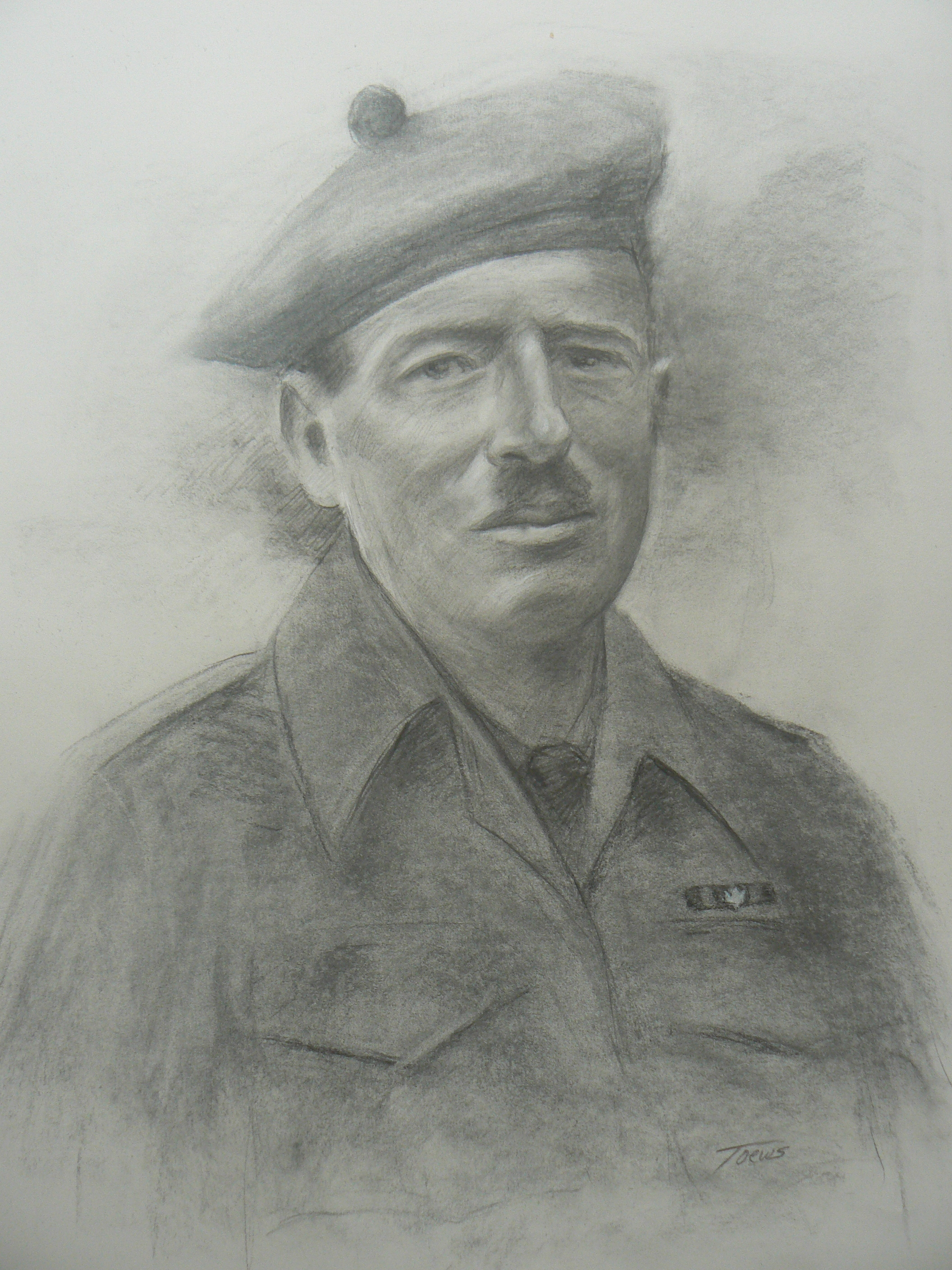
In 2003, the Logie family presented a beautiful portrait of LCol W. A.
Logie to the Officers’ Mess in memory of Major Alexander Chisholm Logie
(1906-44). Now, in 2013, Robin and Joy present a charcoal portrait of
their father. From the end of the war until their deaths, the men of 18
Platoon, D Coy, made a habit, whenever they were together, of raising
their first glass to the heavens. As Pte J.N. “Mac” Mackenzie explained,
“It’s for Skin [the troops nickname for Logie], always has been, always
will be.” This is the sort of honor that no one can bestow, it is
earned, never awarded.