
At the turn of the 20th century, a number of Hamilton’s
Scottish-Canadian organizations organized politically for the
establishment of a kilted regiment as a visible symbol of Scottish
culture as it was understood. The movement’s leading figures were
Presbyterians. Despite the initial opposition of the Liberal government,
the 91st Highlanders were gazetted on 16 Sept. 1903. On that day,
the Reverend Neil McPherson, minister of St Paul’s Presbyterian became the chaplain
of the new Regiment. It was no mere coincidence. One of the founders of
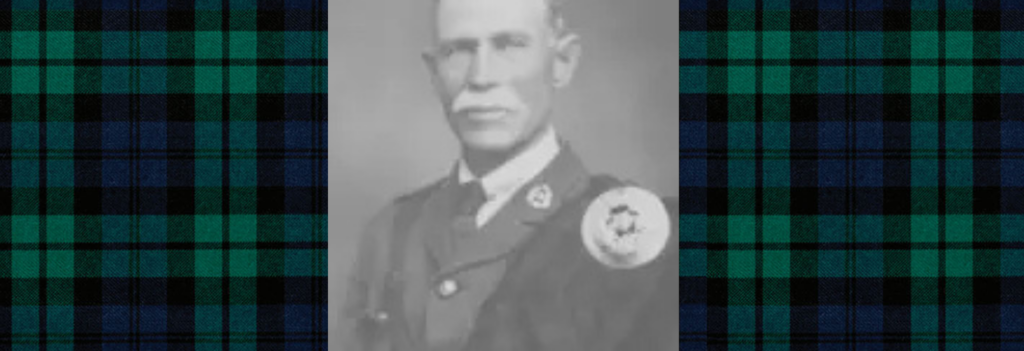
the Regiment and its first Commanding Officer, Lt-Col William Alexander
Logie, was a leading member of the congregation. McPherson was
succeeded as chaplain by the Reverend Doctor Daniel R. Drummond
(1868–1931) on 2 Oct. 1905 and St Paul’s continued as the Regimental
church.
There were annual church parades to the church, and the chaplains
presided over the usual duties associated with a regimental chaplain:
births, marriages, and deaths. In October 1928, the Regiment, on the
occasion of its 25th anniversary, trooped a new set of Colours; its
first set were laid up in St Paul’s, where they remain today. Three days
after Drummond’s death, on 12 Oct. 1931, the Regiment had a new
chaplain, Dr William Barclay of Central Presbyterian Church in Hamilton.
After 28 memorable years at St Paul’s, the Regiment acquired a new
Regimental church and chaplain, and its direct association with
St Paul’s ended.