
The outbreak of the Second World War in 1939 occasioned soul-searching
in one young American born in Spain in 1919. Well educated and possessed
of a fine mind and a romantic sensibility, young Hugh Maclean was
determined, like his father had been during the First World War, to serve with a
Highland unit. In the summer of 1940, he travelled from New York to
Ontario to join a Canadian unit. As luck would have it, the 48th
Highlanders had reached their establishment and he was sent to Hamilton.
Having spent a night in a rundown Hamilton hotel, which Hugh imagined
was some version of hell as envisaged by Dante, he joined the unit. He
had a BA and the adjutant, Johnny Farmer, thought this qualified him to
be a clerk in the battalion orderly room. Hugh was taken on strength and
spent his first night as an Argyll in the makeshift Stanley Barracks, a
place awash, as he put it, “in blood, urine, and vomit.”
Young Maclean, a modest soul if ever there was one, made an impression.
On 3 Sept. 1940, Intelligence Officer Don Seldon noted in the
war diary an episode that brought credit to Maclean. But Seldon took the
opportunity to get something on record about this rather unlikely
private:
Born in Aguilas, Spain, 21 years previously, of Scottish parentage, he
had graduated from Princeton university with his B.A. degree, and had
being continuing his studies in New York City when the Argylls
mobilized. The call of the blood overcame the seeking for knowledge
which has always distinguished this young man, and he was one of the
first outsiders to enlist with the Argylls, being sworn in on June 26th,
1940.
Later in the month, Maclean was commissioned from the ranks along with
Jack Harper and Bill Milner. Maclean recalled:
They [all ranks] tried to help me, and I can remember figures or NCOs who really helped me …
I really look back on those days with wonder and amazement. It’s really
incredible I knew so little and that I was treated with such tolerance…. It’s very moving for me to think of that.
He also recalled the “wetting of his pips” in the Officers’ Mess and having to be carried
out.
Maclean carried out his duties, took his courses, noted with wonderment
the goings-on of Regimental life, and became a transport officer. By the
time the Battalion was in Jamaica, it had acquired transport. On one
occasion there, “after a few drinks,” he took it upon himself to ask Gen
Neil Ritchie “a few questions about how Stonewall Jackson would have
fought in the desert. And Hay [the adjutant] took me aside into the
Mess and said, ‘Maclean, don’t you ever speak like that to a general
officer.’ He said, ‘I think you better go back to your barrack now.’ So
I did.”
Maclean had another encounter with Hay in September 1943. Hay was acting
commanding officer (CO)and the new CO, Dave Stewart, was with him. Hugh
had authorized the use of the CO’s vehicle and, shortly thereafter, the
CO wanted it. He was called to the CO’s office:
“Who gave the authority, Maclean?” He [Hay] tore a strip off me the like
of which I’ve never had, right in front of Stewart. He really tore a
strip off me, and he was right. And I sort of crept back to my tent and
the next thing I remember is that a shadow came across the tent about
fifteen minutes later, and it was Stewart. And I thought, “Oh, God. I’m
going to get it again.” And I got up and he said something like, “That
was a damn foolish thing to do.” I said, “Yes. Yes it was, sir.” And he
said, as I recall, “Well, don’t do it again, will you?” I said, “No,
sir.” And I was Stewart’s from that time on.
Maclean became the officer commanding the Bren gun carrier platoon. By
July 1944, they were in France and, at this juncture, he became acutely
aware of what might be next:
the moment I suddenly said to myself – and typical of me, so late, so
dumb really – the moment I said to myself, “Wait a minute, the only way
I’m going to get out of this is to be wounded badly enough to get sent
back to England, or killed, or behave in some cowardly way” … that
moment occurred to me after we had been over in France for the first day
and we were sitting playing cards in some field. And suddenly, reality
hit me. I thought, “Wow, this is really it.” And a few days later, I was
hit. I guess I was the first officer to be hit. And I hadn’t thought –
I hadn’t permitted myself to think – about it much. So strong was the
romantic aura, I guess.
His sense of foreboding proved prescient. Hugh Maclean was badly wounded
on 2 August in one of the unit’s first engagements:
About 8 o’clock, I went out and around to all the pits. They were all
quiet and pretty tense, but seemed a hell of a lot more dependable than
I felt myself to be. [A/L/Sgt] Guild, especially, with his broad Scots,
made me feel pretty good. In fact, I felt so good that I stood up, tired
of the crouching run between posts, and moved back to the entrance of
the dugout that way, still half erect. So perhaps what happened was my
own fault … I sat down at the edge of the dugout entrance, half in and
half out of cover. Almost at once, there was a deafening crack,
accompanied inseparably by the same hot rush of air I’d felt from the
close one earlier. There was no warning whine, nor had I heard – as the
books will tell you when your special shell is on the way – the
explosion in the enemy rear. I did think, “Christ, that was really
close,” but discovered at once, and to my intense surprise, that I was
flat on my back inside the dugout. Right across from me sat P_____,
looking exactly like a terrified rabbit, staring, fascinatedly at me.
Then I found that I couldn’t breath. Well, not precisely that; but that
there was a fearful tightness in my chest, and only shallow gasps could
come … I looked down at my chest. Then for the first time I was really
afraid. Instead of the familiar battle-dress tunic, there was a big,
confused splotch of red, brown and white, spreading while I watched …
I opened my mouth, and, with an effort, croaked, “Get Foster.” He ducked
out at once. I hardly noticed his departure, obsessed with a new
problem. As I’d mouthed the words, a trickle of blood came out with them
and slid down my cheek … From the dark recesses there was a little
whisper, “You’re going to die, Maclean.” And another, hysterical one
cackled, “This is it; just like in the books … THIS IS IT!”
Bob Paterson, later Hugh’s brother-in-law, remembered: The first casualty [that] hit you was [Capt] Hugh Maclean at Bourguébus. I heard
about it immediately…. Those early ones hit you, but after that…”
For Maclean, the wound meant six weeks in hospital and then another two
weeks of recovery before he was ready to return. By 25 October, he was
back.
The first thing I saw was a jeep-load of dead men. When they let me
out, here was a jeep of our people. And they were all covered with
blankets and all we saw was the boots sticking out. Some return.And [I] went over to the Carrier Platoon, and they seemed to be
overjoyed to see me. It was so lovely. And they were just serving out in
these mess tins…. So I … was served something. And at the moment,
there was a mortar shelling going on maybe fifty yards away in the
woods, something like that. And then one came quite close, and I
remember I was holding the stuff in the mess tins like this, and when I
came down I went “Umph,” and the stuff went right out of the mess tins
and back into those [same] tins. And I looked quickly at [Sgt] Foster.
Nobody said a word. Nobody laughed or anything … I thought, “Okay,
I’ll just have to get a hold of myself.”
Maclean settled in again to life in the Battalion. Aside from the grim
business of battle, there were mild diversions of the sort that allowed
some remote semblance of normalcy. The adjutant, Capt Mac Smith, wrote
in November to his wife that: Indoors, I play chess with a skilful
Semite named [Kurt] Loeb, who always beats me, and argue about politics,
culture, etc. with [Claude] Bissell and [Hugh] McLean [Maclean] (Cornell
+ Princeton).” Bill Whiteside, OC Support Coy, recalled that
“Maclean, Bissell and Smith were just a complete joy whenever they
got together … crazy, crazy talk. They would think up a subject to
discuss and go into ridiculous lengths.” Padre Charlie MacLean shared
Whiteside’s evident joy: “It was quite an intellectual feast, as they
were all very well-informed men.”
On 29 November, Maclean’s carrier platoon put on a flame-throwing
display for the Supreme Allied Commander, General Dwight Eisenhower:
I didn’t think we were going to be able to do it
properly, and I made representations to that effect to someone or other
in the Regiment.And I was told, “It doesn’t make any difference, you gotta do it.” So we
did it, and it made quite a big hit. At any rate, old Ike stood next to
me and said – as they came flaming up – “Hot damn!” he said, “That’s
great!” And then he shook hands with me and said, “Great platoon,
Captain,” and away he went. And I thought, “Well, okay, I guess it
is.”
There was also time to help a young reinforcement officer, Lt Alan Earp,
find his way to the Argylls. Hugh was a friend of Earp’s sister. On 29
November, young Earp, as he was always called, wrote in his diary: “I
messed with the Argyles & Hugh introduced me to the Colonel [Dave
Stewart] (now D.S.O.) whom they all worship & said I wanted to make the
Argyles [sic]. He asked why & then said he would try to fix it.”
Maclean, like others, was weary from the strains of battle. Ever
diffident, he declined LCol Fred Wigle’s offer of command of Support
Company. In fact, Maclean recommended another officer; an irritated Wigle
had to be convinced by Adjutant Claude Bissell not to transfer Maclean. In
time, however, he would command it. On 8 April 1945, Mac Smith, OC,
Support Coy, was killed while standing beside Lt Alan Earp during a
canal crossing. “Wigle called me in and said, ‘You’re appointed to
Support Company, Maclean.’ And I said, “Alright, sir,” and I …
staggered through for the rest of the war.” Several days later, Wigle
was killed and Earp badly wounded. Hugh wrote to Alan Earp’s sister:
“I need hardly say that he was conducting himself in a very gallant
manner at the time. I saw him myself approximately one-half hour
afterward, and he was as cool and self-possessed as ever. He is of
course a wonderful guy and a fine officer. I am proud to call him my
friend.”
The last weeks of fighting proved bitter. At the Kusten Canal, on 21
April, Maclean and his sergeant tried to relax after being forward with
the rifle companies:
After they’d all gone, Sergeant Anderson and myself left the house and
walked back slowly through the fields. I felt very tired now that the
tension was relaxed and we just plodded along in silence. When we got to
the road, though, we were feeling better at the thought of a hot meal
and maybe some sleep for a little.We got into the jeep, Anderson turned her, and we started down the road.
I said, “Well, never a dull moment” or something of that sort. He opened
his mouth to answer but the sound was lost in a terrific crash just
behind us on the road. I didn’t have long to fling that one glance back
at the billowing dust to know that the long-silent 88 was trying for us.
I said, “Step on it, for Christ’s sake!” but the jeep was already
leaping ahead; then, another stunning explosion, right in front this
time, sending steel splinters and pieces of road surface flying around
us. Anderson jammed the jeep to a slithering stop and we flung ourselves
out, diving for the side of the road; though I remember thinking
something like “This is the one, you can’t get away this time, you
haven’t got a chance.” I’d certainly never been in as nasty a spot
before; he had us right in the open and his shells were hitting right
there, they came in an uninterrupted stream and they exploded on the
road itself. It was impossible that we should escape. I knew it, and
lay, quivering, deafened by the continuing roar. I was utterly
terrified. It was as if some malignant giant stood over us with a spear
and vindictively, not idly, thrust at us. My mind rushed back to the
first time and tried to recall what being hit had felt like; but I
couldn’t even concentrate on that; because this time I was really badly
afraid; before, I hadn’t known enough to be. And yet, even in that
moment of absolute terror and the feeling of being marked for
destruction, a little corner of my brain kept saying “Maybe, maybe
you’ll be lucky.” All the rest of me, all the reasonable parts screamed
in certainty of doom, but the other little bit kept on being perverse,
though it knew things couldn’t turn out that way. I can’t even say that
I prayed, or thought for a moment about God, or even (and this I’d not
have believed) about loved ones; at other times of danger, with death
hovering but not quite so imminently and all-powerfully present, such
things were in my thoughts, but not this time. This was the worst one.
This didn’t leave room for anything but paralyzing fear – and the
impossible, emotional hope.The shells felt for us, searching all around, tearing the air above and
on all sides with their vicious fragments, ripping the trees to bits,
punching new holes in the concrete road. A tiny splinter, no larger than
a pin, did, indeed, enter my leg; I felt it, but the sensation, only
momentary, rushed away at once with all other thoughts. Only later did I
remember, and examine the scratch. There came a pause, perhaps a few
seconds; Anderson yelled, “Let’s go”; I croaked “No,” and was at once
vindicated as another salvo initiated a renewal of the awful
hammer-strokes. Perhaps instinctive caution guided me; more probably (I
believe) my limbs would simply not at once obey the effort to move. For
the dragging minutes (five? ten? a life’s span, in any case) the storm
raged about us. We were not hit.The gun packed up finally, of course. After waiting a moment more in the
sudden echoing stillness, we got up laboriously and made our way down
the road, toward headquarters. The gun let us go. As I turned up the
path, I experienced another thing I’d read about and heard of, but which
had never before happened to me: my legs were suddenly water. I had to
grab for a tree; Anderson and I grinned weakly at each other, muttering
the usual banalities. In a few seconds it was all right. I went on in
and sat down on the floor. [Capt Claude] Bissell looked at me, and got
right up, poured out a big crack of rum, and gave it to me. I put it all
down at a gulp. Soon after that I felt better.This was the worst one. They’d hit me before, of course, but at the
beginning, when we were all too green to be properly aware of things.
That hadn’t been nearly as bad. I think what made this one especially
terrible was the feeling that a particular and accurate gun was trying,
specifically, to hit two particular people – Anderson and me. A sniper
does that, of course; but a sniper shoots with a Schmeisser or a rifle;
this was a sniper with an 88. That’s loading the dice. As well, both of
us had seen plenty of dead ones, and we didn’t fancy ourselves ending up
on some lousy little fight after all the big stuff we’d come through….
We should have been killed there, on the road; but we survived. It was a
miracle. But it finished me. My nerves were shot from then on; and the
rum-jug, never before any particular crony of mine, became gradually
more important. I went on, all right, and got shot at by plenty of other
guns, and even stuck my neck out, once, near Bad Zwischenahn; but I
wasn’t the same, and I knew it, even if not too many other people did.
But if the war had lasted, say, two weeks or more than it did, I’d have
been sunk. Lying there on the road, my imagination had started to work
again, after a long coma; and when that happens, it’s only a matter of
time.
After Kusten, tough going became even tougher. For Maclean, “after
Küsten, some sort of bloody big stuff came down and something near me,
and I was so shattered. I got right under the stove, which was almost
impossible, in that building. And I remember thinking later, ‘God, I’m
really getting in tough shape. This isn’t good…’” Mercifully, the war
soon ended. The new CO (Wigle was killed on 10 April) sent Maclean back to
England, where he wrote the history of the lst Battalion.
After the war, Maclean took an MA and PhD in English at the University of
Toronto. Subsequently he taught at the Royal Military College, the
University of Cincinnati, York University, and, from 1963 until he
retired in 1986, at the State University of New York at Albany, where he
received the Chancellor’s Award for Excellence in Teaching. From 1974 on,
he had held the rank of distinguished teaching professor. Siena College
awarded him an honorary doctorate of humane letters in 1991. He authored
and published articles and reviews in numerous literary journals,
primarily on English Renaissance literature. With LCol Sir John
Baynes, Bt., he published in 1990 A Tale of Two Captains, a memoir and
letters recording the military experiences of the editors’ fathers in
the British Army during the First World War. Earlier, he served as president of the
Spenser Society; his history of the Argylls was published – albeit (and
sadly) unattributed and sandwiched between two rather insipid chapters,
lists really – outlining the Regiment’s history from 1928 to 1940 and
from 1946 to 1953.
Hugh Maclean married Janet Malcolm Paterson, Bob Paterson’s sister, in 1949; the
reception was in the Argyll Officers’ Mess. They had three children: a
daughter died early in life, but his wife, daughter Susan Mary Buda, and son Alan Peter survived him at his death in December 1997.
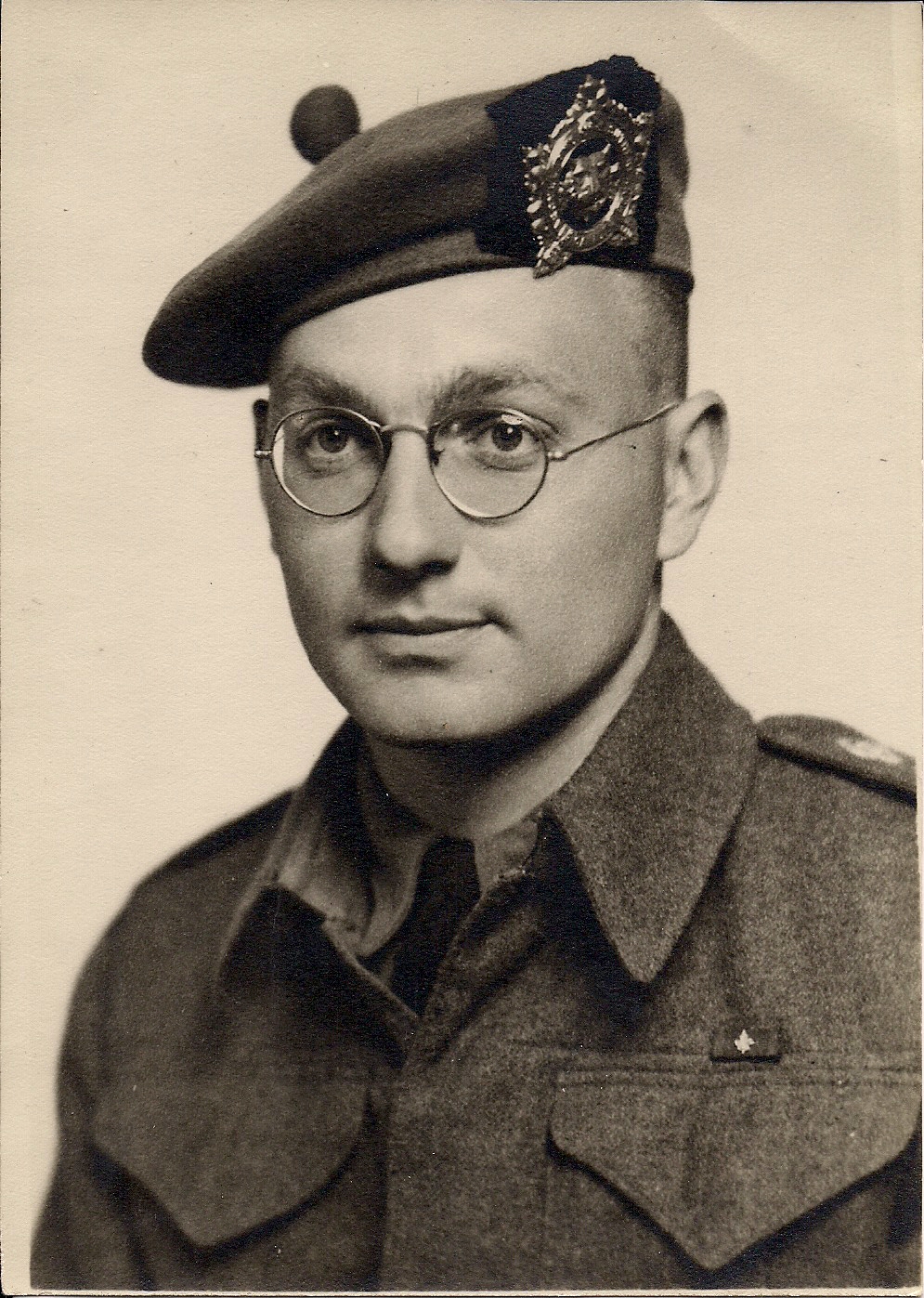
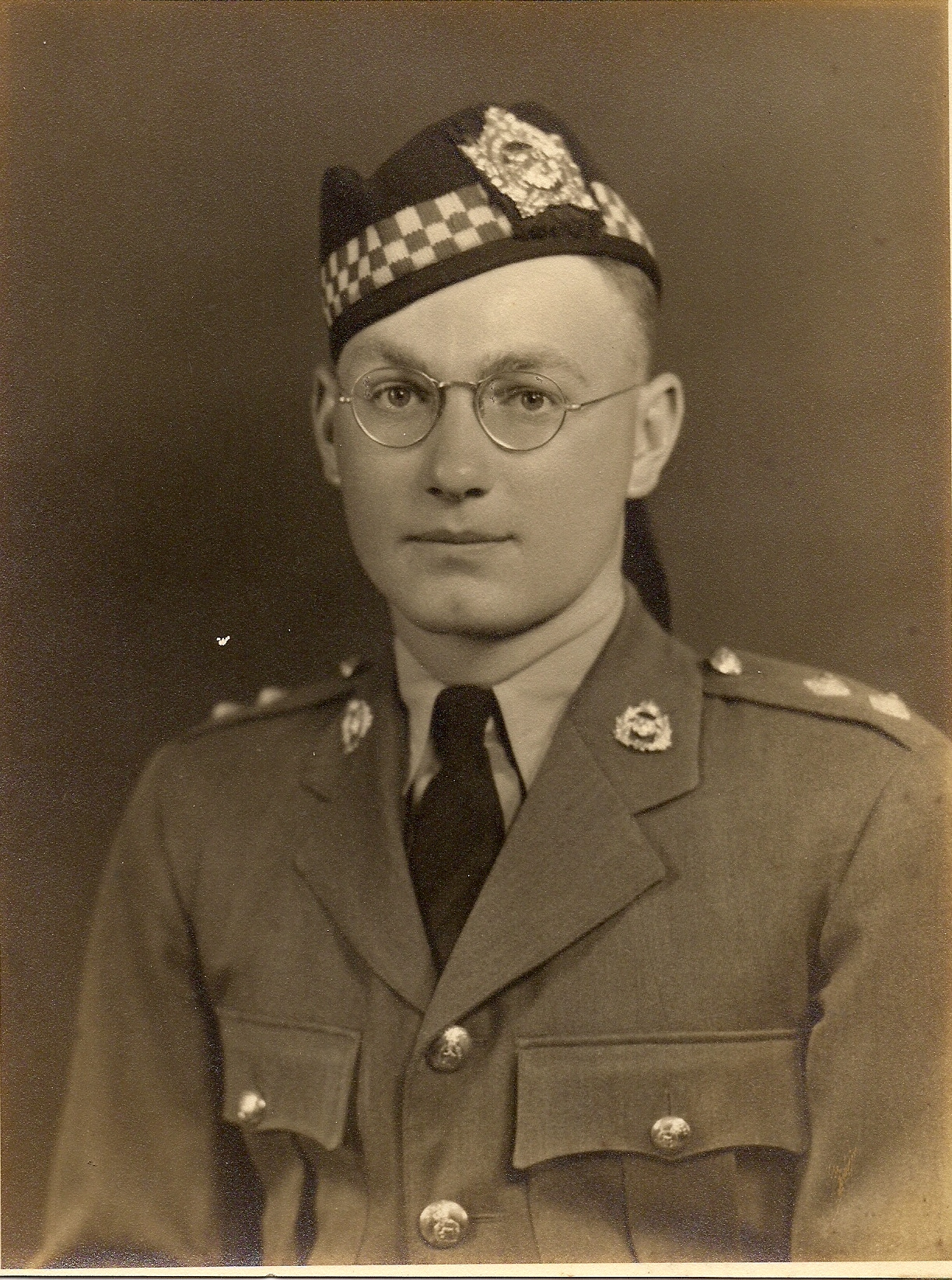
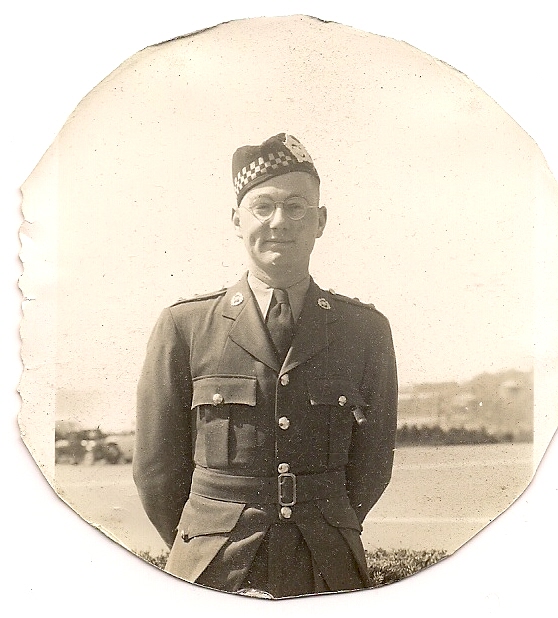
Like so many fine wartime officers, Hugh Maclean got on with an
interrupted life after the war. But the Regiment was never far from him.
He joined his wartime comrades-in-arms for mess dinners in the late
1980s and the early 1990s; he wrote an eloquent forward to Black
Yesterdays, and, in 1986, he delivered what is considered the most
moving Toast to the Regiment in the Argylls’ long history. He captured,
at once, the essence of the spirit of Argyll soldiering, in memorable
and oft-quoted terms:
As I leafed through our earlier regimental history of 1953 … I
recalled, with a rueful sigh, and some pain, what Jonathan Swift in old
age murmured as he read his earlier works: “What a genius I had then!”
Mine was a rueful sigh, of course, because all I could say to myself as
I browsed through those pages, with their youthful fondness for
adjectives and their too frequent sentimentality, was, rather, “My salad
days, When I was green in judgement, cold in blood, To say as I said
then…”Still: at least I had then the wit to recall Bunyan – “Yea how they
stood in battle array, I shall remember to my dying day.” And the
historical section had sense enough to leave that passage on the
title-page. And, in fact, as I read the story over again, something of
the regiment’s character – as I felt its subtle power in those war
years (even, dimly, began to understand the roots of that power) – some
things that were central to the regiment’s character loomed again
through the mists of failing memory. I thought first of the regiment’s
cheerful humanity. Then, of the regiment’s extraordinary morale. And at
length (and most piercingly) of its inimitable style, with which the
regiment adorned all its occasions, in and out of battle. And if my
remarks … necessarily look to my years with the First Battalion, let
me emphasize that the battalion’s humanity, morale, style continuously
of course, in a larger sense, reflected the traditions and quality of
the regiment itself, over the years since 1903: its Scottish tenacity
and verve, its Canadian common sense and taste for irony, its soldierly
bearing and pride – still ready at hand to confront threats of every
sort…The regiment’s humanity came first, for me: its considerate and cheery
kindness to all its sons, not excluding even this innocent stranger,
never a “real soldier” so much as “a harmless young shepherd in a
soldier’s coat” (as Edmund Blunden calls himself in Undertones of War),
who came to the wars, most fortunately, by way of Johnny Farmer’s office
in the Armouries on a very hot July day in 1940. I was a stranger, as
scripture has it, and ye took me in. I experienced the regiment’s
humanity in so many ways. That other bit from scripture has point here,
as it happens: I was thirsty, and ye gave me to drink. One threat in the
crazy-quilt tapestry of Maclean’s military career, such as it was
(knowing nothing of women and unable to carry a tune) records the
continuing series of disastrous encounters with strong drink – in the
effort, I suppose, to assert manhood, or some such thing. The ceremonial
wetting of my pips in the Sergeants’ Mess soon turned to a drenching –
but my wiser fellows, Jack Harper and Bill Milner, always ready at hand,
saw me gently to bed. There was a memorable 2-day hangover in Montego
Bay (I seem to recall); others at Up Park Camp; later again at Uckfield
House. A melancholy tale! Yet the regiment took an amused and tolerant
view of all that. And when more serious slips came in question –
mistakes of judgement, stupid errors – the regiment’s humanity bore me
up, in effect saved me from myself. And this extended to all our ranks:
private soldiers, sergeants and sergeant-majors as well as officers.A little curiously, perhaps, the regiment’s humanity and persistent
good-fellowship is epitomized for me by the group who met nightly in the
Mess at Up Park Camp for their post-prandial poker game: Pappy Coons,
Mait Roy, Jack Wright, Lee Craven, Jack Bell – and the rest of that
memorable band. Sitting in a quiet corner with the London News, I
positively shivered with pleasure as I watched and listened to those
warriors at play – especially Pappy Coons, raising his arm high for a
card, would joyfully shout, “Be careful and hit!” What I thought was,
“How exciting, how delightful, to be a part of all this … I wonder
what will happen next.” Their strong and cheerful humanity reached out
to me then – and it does still…Musing on what the regiment meant to me, I think too of that soldierly
virtue, morale. In his wonderful book on that topic, Colonel John Baynes
seems at length to identify it, in war, as the soldier’s absolute
determination to do his duty to the best of his ability in any
circumstances. Baynes takes for his model and example the Second
Battalion of The Cameronians, at Neuve Chapelle in 1915. Yet the actions
of our own regiment might equally have served: for choice, perhaps, Hill
195; Gil Armour’s platoon at St. Lambert; Paterson and Mackenzie at
Moerbrugge; Armstrong and McCordic at Bergen-op-Zoom; Wigle at
Friesoythe. Whiteside and all the rest on the Kusten Canal. The names,
the encounters epitomize morale in action. But as Baynes takes care to
notice, these active effects have their several causes. He speaks in
particular to the role of wise, thoughtful, compassionate leadership;
and to that of “intense group loyalty at every level.” For this latter,
I need say only that the intense group loyalty which took flame at Hill
195 burned as brightly at the Kusten Canal – and at all the battles
between……leadership matters too – most of all, no doubt. We were lucky in
this as in so much else: leadership and to spare up and down the ladder
of command. But the best of our leaders was Dave Stewart. Wise,
thoughtful, and compassionate he was, as Baynes could wish. Cheerful and
courageous, whatever winds blew, what top-brass changes of plan
bedeviled his careful arrangements. And something else – something very
unusual indeed. T.E. Lawrence remarks in The Seven Pillars of Wisdom that:“… the greatest commander of men was he whose intuitions most nearly
happened. Nine-tenths of tactics were certain enough to be teachable in
school, but the irrational tenth was like the kingfisher flashing across
the pool, and in it lay the test of generals. It could be assured only
by intellect, sharpened by thought practising the stroke, until the
crisis it came naturally, a reflex.”Such was the gift of our finest leader, Colonel Stewart, chief source
and root, at last, of our regiment’s high-spirited morale – whatever
might befall.I think finally of the regiment’s style … Of course there were
individual styles of every sort within our ranks. The spirit of Culloden
and the ‘45 that flashed again through Al Logie; the stalwart,
unassuming, old-shoe style of Pete McCordic; Lloyd Johnston’s laconic
street-smarts; the composed, quiet strength of a Mackenzie or an
Armstrong. Bill Whiteside’s coolly amused insouciance. And in some sense
of course the regiment’s style was Stewart’s style … there was a
battle to win, or lose, and a certain style to maintain. A manner, if
you like, with which to confront the inscrutable face of battle, and
endure in spite of it.Our own leaders knew all about that. The world may be a dangerous place,
but one has a part to play just the same. Much the best, then, to act
with style – to cultivate a touch of class. I call our regiment’s style
one of cool gallantry; a style regularly serious, but never solemn; the
style of a regiment in every passage-at-arms marked by grim
determination and resolve; yet resilient enough to endure with good
cheer, even a light heart. A style that pulsed through the regiment and
drew us together – as, if you will, Mac Smith could draw us together in
his common “doctoral” denominator. For Mac Smith, we were all doctors,
in the discipline of war – of life, at last, and death too.…I did not “grow up” in the regiment – that came later, with the
thrust and parry of graduate school at Toronto. The years have shown me,
however, that the regiment was, of all my teachers, the most powerful
and subtly influential. The regiment taught me much. But I think chiefly
of three things. To be a member of the regiment was to know that, if one
might often be lonely, one need never be altogether lonesome — never
altogether alone. The regiment taught me to expect the unexpected: not
to be forever flurried or jarred by chance or happenstance, but to meet
such turns with a measure of equanimity. And lastly — as perfection is
last – the regiment taught me the meaning of humility, and, most of
all, of pride: pride in belonging to the splendid First Battalion of
this great regiment, whose leaders and their men today can still take
for their example the quiet courage, the discipline, the mutual
confidence and good will, the fortitude of those who wore the Argyll
badge in the wars…
Hugh Maclean was a fine soldier, distinguished by his own keen
intellect, his unsparing honesty, his concern for others, and his
doggedness. He styled himself more of a shepherd than a soldier, but
others saw him differently. And, like Alex Logie, he was respected by
the hard-bitten men he led, men whose respect could only be earned, men
like Danny Anderson, George Guild, and Frank Foster. The life-long
admiration of such men is equal to an honorary degree or a medal; at
least it is in the estimation of soldiers.